

When people think about the reasons to move to Hawley, they usually talk about the fresh mountain air, the serene lakeside lifestyle, and our wonderful, tight-knit community. But one of the most unique aspects of making this town your home is that you aren’t just moving to a beautiful destination—you are moving into a place where American history is woven right into the fabric of daily life.
Long before Hawley became the peaceful getaway and vibrant community we love today, it was a thumping heartbeat of the American Industrial Revolution. In the mid-1800s, our town served as a major transportation hub, acting as a critical transfer point for the Delaware and Hudson (D&H) Canal and the Pennsylvania Coal Company’s gravity railroad. Millions of tons of anthracite coal moved through here on its way to light up New York City. When the coal era shifted, Hawley reinvented itself as a textile powerhouse, pulling in workers and innovators who built the beautiful stone structures that still define our skyline.
Living in Hawley means having a front-row seat to this incredible heritage, and you don’t have to look far to find it. You can see and experience this history every single day right here in town.
Historic Landmarks in Town
The crown jewel of our local heritage is the historic Hawley Silk Mill. Built in 1880, this massive structure stands as the largest monolithic bluestone building in the world. It survived fires and economic shifts, operating as a silk and textile mill for nearly a century. Today, instead of fabric looms, it serves as a vibrant community hub filled with local shops, a bakery, offices, an art gallery, and a local college campus. Having Lackawanna College locate its Lake Region Center right inside this historic landmark brings an incredible dynamic to our community. It blends the preservation of our past with a bright investment in our future, offering vital educational and professional development resources right here in town so residents don’t have to commute to a major city to advance their careers or complete a degree. When you move here, walking through these historic doors to grab your morning coffee, browse local art, or pursue higher education feels like stepping directly into a beautifully preserved piece of 19th-century architecture that is still working hard for the community today.
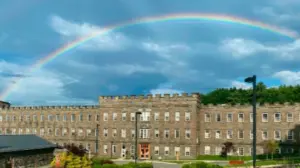
The historic Hawley Silk Mill. Source: www.hawleysilkmill.com
Right in the center of town sits another historic treasure that anchors our community life: Bingham Park. Dedicated in 1930, this gorgeous green space was gifted to the town by the heirs of William Bingham, a prominent figure whose family line ties directly back to early land development in Pennsylvania. For nearly a century, this park has served as Hawley’s town square and public backyard. Long before children played on its grass or baseballs were hit across its diamonds, this very soil was a massive, water-filled canal basin and boatyard for the D&H Canal Company and the Pennsylvania Coal Company’s
transfer facilities. It was a bustling, muddy, industrial hub where coal cars coming off the gravity railroad emptied their heavy cargo into waiting wooden canal boats. Once the canal era drew to a close at the turn of the 20th century, the basin was drained and filled in, eventually becoming a local playing field before the Bingham family stepped in to secure it as a public park.
Today, this incredible transformation from a muddy industrial site to a community oasis comes alive every single week, as Bingham Park features a thriving weekly farmer’s market. Moving here means spending your Friday afternoons strolling under the old canopy trees, buying fresh local produce, organic meats, baked goods, and handmade crafts right where canal boats used to float. Its most prominent historic feature overlooking the market is the beautiful, rustic log cabin pavilion built by the community out of native timber during the Great Depression. While historic records detail its log cabin construction, if you ask anyone around town, they will point you right to it as **”the gazebo”** or the bandstand. Standing today as a powerful symbol of our town’s resilience, grit, and enduring community spirit during challenging economic times, this iconic octagonal structure is the central gathering place for summer concerts, holiday tree lightings, and generations of neighborhood memories. Moving to Hawley means gaining a neighborhood park that isn’t just grass and trees, but a storied gathering place where neighbors have connected for nearly one hundred years.
Trails, Rail Corridors, and the Making of the Lake
For a deeper look into the region’s transport past, you can head just past the edge of town to explore the D&H Canal Park at Lock 31. This area is a fantastic focus for ongoing community expansion, specifically through the multi-use Hawley Trail project. Championed by the Wayne-Pike Trails and Waterways Alliance, this trail network is steadily growing, stitching together local green spaces like Bingham Park and Lock 31 with a multi-mile path that eventually stretches all the way toward Lake Wallenpaupack.
The expansion at the Lock 31 park honors the classic canal era by featuring the original 1820s Daniels Farmhouse, which served as a historic lock house where the lock keeper managed the water levels for passing boats. It is one of several remaining lock houses scattered along the Lackawaxen River valley, which served as the lonely outposts for the families who kept the canal moving day and night. As part of the ongoing efforts to bring the canal days alive, the park features a full-scale replica of a D&H canal boat, giving you an immediate sense of the sheer scale of the wooden vessels that once navigated these waters.
Yet, the absolute best part about the D&H Canal Trail is how incredibly versatile it is. You don’t have to be a history buff to love it. In fact, it is the perfect place to completely ignore the historical context, tune out the noise of the world, and just enjoy walking your dog in nature. The trail follows the historic flat towpath directly alongside the rushing waters of the Lackawaxen River. It is lined with magnificent canopy trees, rare plant varieties, and local wildlife, making it an incredibly peaceful, shaded escape. Whether you are letting your four-legged friend sniff the river breeze or just enjoying the rhythm of your own footsteps under the trees, it serves as a gorgeous reminder of why the natural landscape is one of the ultimate reasons to relocate here.
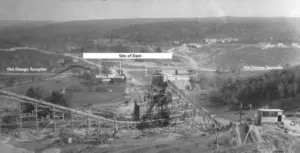
The construction of the Lake Wallenpaupack dam in the mid-1920s. Source: Wally BITES, LLC.
Just past the trail lies the definitive reason Hawley is such a thriving playground today: Lake Wallenpaupack. While it feels like a natural part of our mountain landscape, this massive 5,700-acre lake is entirely man-made, created by an extraordinary engineering feat in the mid-1920s. Pennsylvania Power & Light (PP&L) dammed the Wallenpaupack Creek to generate clean hydroelectric power. Its significance can’t be overstated; the project completely transformed the region’s economy from declining industrial manufacturing to a premier Mid-Atlantic vacation and residential destination.
The creation of the lake is also wrapped in poignant local lore. To clear the valley for flooding, PP&L had to acquire roughly 12,000 acres of land, which meant dismantling entire homesteads, moving roads, and relocating a historic village called Wilsonville. Hundreds of graves from early family cemeteries had to be meticulously exhumed and moved to higher ground. Today, the massive 1,280-foot concrete dam stands as a monument to that transition, and the water it holds back provides endless boating, fishing, and lakeside living right in our backyard.
Part of the magic of living in Hawley is our proximity to neighboring historic gems that make for perfect afternoon trips. Just a short drive north sits Honesdale, a historic town that holds the permanent, legendary title of the Birthplace of the American Railroad. On August 8, 1829, the imported British steam locomotive named the Stourbridge Lion made its first run on the tracks there. Today, you can discover this story at the Wayne County Historical Society Museum, housed in the original 1860 D&H Canal Company office building, which features a full-scale replica of the famous locomotive. Even better, you can actually ride a piece of that history on the Stourbridge Line excursion train, which takes passengers on a scenic journey along the Lackawaxen River valley using the very same rail corridor that helped build our region. Plus, people can also now ride directly on these very same historic tracks using custom, bicycle-type rail cars. Operating seasonally right out of the Hawley depot, these electric-assist tandem and quad railbikes allow you to pedal smoothly down the line, offering an immersive, open-air perspective of the river valley that connects our community’s rail legacy with modern outdoor recreation.
White Mills and the Gilded Age of Glass
Traveling just a few minutes west of Hawley brings you to White Mills, home to one of the most glamorous chapters in American craftsmanship: Dorflinger Glass. In 1865, Christian Dorflinger, a brilliant French-born glassmaker, moved his operations from Brooklyn to our rural valley, seeking the pristine local water and peaceful environment to focus on luxury cut glass.
Dorflinger glass was so remarkably clear and beautifully cut that it became the definitive choice for American high society, gracing the state dinner tables of several U.S. Presidents, including Abraham Lincoln, Ulysses S. Grant, and Woodrow Wilson.
At its peak, the Dorflinger Glass Works employed over 600 master craftsmen, turning a quiet river hamlet into a world-renowned center of fine art. The factory eventually closed in 1921 as tastes shifted and Prohibition devastated the market for fine crystal barware, but its glittering legacy remains beautifully preserved. Moving here means having the Dorflinger-Suydam Wildlife Sanctuary right down the road. Spanning 600 acres, it pairs gorgeous, peaceful walking trails through quiet woods with the Dorflinger Glass Museum, which houses the nation’s largest single collection of this rare, radiant Brilliant Period cut glass.
Across the Lackawaxen and Delaware Rivers
If you trace the old canal path down to where the Lackawaxen River empties into the Delaware, you will encounter the breathtaking Roebling’s Delaware Aqueduct. Now known simply as the Roebling Bridge, this spectacular engineering marvel was designed by John A. Roebling, a brilliant German-American civil engineer who pioneered the use of wire rope suspension and went on to design the legendary Brooklyn Bridge. Roebling originally built this aqueduct in 1848 for a very specific, vital purpose: to eliminate deadly traffic jams on the river. Before the bridge existed, canal boats crossing the Delaware River were routinely smashed by massive timber rafts drifting downstream or stalled out by shifting river currents. Roebling’s structure lifted the canal completely into the air, allowing water-filled wooden trunks to carry heavily loaded coal boats safely right over the rushing river. It stands today as the oldest existing wire suspension bridge in the United States, allowing you to literally drive or walk across a piece of national history.
Directly across the river from the Lackawaxen confluence sits the historic Minisink Battleground Park in Barryville, New York. This 57-acre forested park marks the sacred site of the Battle of Minisink, fought on July 22, 1779. It stands as the Upper Delaware Valley’s only major Revolutionary War skirmish, where a hastily assembled Patriot militia clashed with a force of Loyalists and Iroquois warriors led by the famous Mohawk leader Joseph Brant. Today, you can walk the quiet loop trails to explore historic markers like Hospital Rock, where a local doctor bravely tended to wounded soldiers during the militia’s tragic last stand.
Right next to the Roebling bridge on the scenic Pennsylvania riverbank sits the Zane Grey Museum. This beautiful property was the actual home of the legendary author Zane Grey, who famously pioneered the Western literary genre with his masterpiece novel, Riders of the Purple Sage. Living in this valley fundamentally inspired his early writing career, but Grey wasn’t just a master of words, he was also a fisherman of legendary skill. He spent endless hours mastering the deep pools of the Upper Delaware and Lackawaxen rivers, eventually translating his local techniques into global adventures where he set multiple deep-sea world fishing records, including catching a historic 1,036-pound tiger shark. Visiting the museum gives you a wonderful glimpse into his adventurous life, his historic novels, and his deep love for the local waters.
Just a few miles downriver in Shohola, you will find Rohman’s Pub (historically Rohman’s Inn), a legendary establishment pouring drinks since 1849. Stepping inside is like entering a time capsule; the bar still retains its historic charm from the Civil War era and Prohibition days when it secretly served patrons. Rohman’s famously drew massive crowds during the roaring twenties and thirties, hosting icons like baseball legend Babe Ruth (who reportedly loved to hop freight trains down the line to grab a cold beer here), early silent film stars like Mary Pickford and Gloria Swanson, and aviation pioneer Charles Lindbergh. To this day, you can view its famous 50-foot hand-carved bar, complete with custom-engineered standing “stools” designed to outsmart an old Pennsylvania blue law and visit its historic 1940s manual pin-setting bowling alley upstairs.
If you continue your journey east across the river into New York, you will find Narrowsburg, a charming town nestled on a sharp bend of the Delaware River. In the 18th and 19th centuries, before railroads took over, massive white pine trees from our local forests were cut down, bound together into giant timber rafts, and floated down the river to build ships in Philadelphia. You can take in this history from the Narrowsburg Observation Deck on Main Street, looking out over the “Big Eddy”, the deepest point in the entire Delaware River at around 113 feet, where rugged timber rafters once steered their massive wooden loads. Just a few miles out of town, you can also hike to see the Tusten Stone Arch Bridge, a gorgeous, hand-laid structure built in 1896 that stands as a quiet testament to early craftsmanship.
While in Narrowsburg, you can visit Fort Delaware Museum, an authentic, meticulously reconstructed depiction of colonial frontier life. The museum represents the historic Cushetunk settlement established in 1754 by daring Connecticut pioneers who traveled into the wilderness to farm the river valley. Enclosed entirely by high log stockade walls, the fort lets you step back into the French and Indian War era, exploring a blockhouse armory, rugged log cabins, a blacksmith shop, and early weaving looms.
A short drive further northeast into Sullivan County brings you to Bethel Woods Center for the Arts. This world-class cultural center sits on the exact, sacred 800-acre hillside property that hosted the legendary 1969 Woodstock festival. Today, it beautifully pairs a state-of-the-art outdoor amphitheater hosting major touring artists with an award-winning museum that chronicles the music, culture, and social shifts of the 1960s.
——–
What makes calling Hawley home so incredibly special is how seamlessly this grand history fits into our modern, everyday lives. We don’t lock our past behind velvet ropes in a museum. When you live here, you buy your morning pastries inside an 1880 silk mill, you attend classes or events in that same bluestone landmark, you shop for fresh local corn and heirloom tomatoes at a farmers market inside a former canal basin, you catch live roots music at the historic Cooperage Project just up the road, and you paddle kayaks past the stone remnants of old canal aqueducts.
The stories of the innovators, miners, railroaders, and loggers who built America are still right here, etched into the hillsides and tracks cutting through our woods. If you are looking for a town with deep roots, character, and a story to tell, Hawley is waiting for you.